


Shopping Cart
Remove All Your shopping cart is currently empty


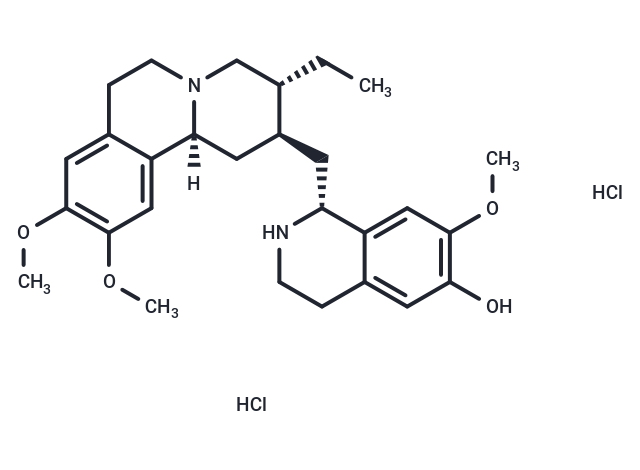
Cephaeline dihydrochloride is a naturally occurring alkaloid that is a selective CYP2D6 inhibitor with an IC50=121 μM. It has an affinity for and oral activity at the 5-HT4 receptor and is capable of inducing vomiting.
| Pack Size | Price | USA Warehouse | Global Warehouse | Quantity |
|---|---|---|---|---|
| 1 mg | $42 | - | In Stock | |
| 5 mg | $98 | - | In Stock | |
| 10 mg | $147 | - | In Stock | |
| 25 mg | $297 | - | In Stock | |
| 1 mL x 10 mM (in DMSO) | $116 | - | In Stock |
| Description | Cephaeline dihydrochloride is a naturally occurring alkaloid that is a selective CYP2D6 inhibitor with an IC50=121 μM. It has an affinity for and oral activity at the 5-HT4 receptor and is capable of inducing vomiting. |
| Targets&IC50 | CYP2D6:121 μM, CYP3A4:1000 μM |
| In vitro | In human liver microsome assays, Cephaeline dihydrochloride demonstrated weak inhibition of major cytochrome P450 (CYP) enzymes. Specifically, Cephaeline dihydrochloride inhibited CYP2D6 with an IC₅₀ of 121 μM and a Ki of 54 μM via competitive inhibition, and CYP3A4 with an IC₅₀ of 1000 μM and a Ki of 355 μM via non-competitive inhibition[1]. |
| Synonyms | NSC32944, NSC 32944, (-)-Cephaeline dihydrochloride |
| Molecular Weight | 539.53 |
| Formula | C28H40Cl2N2O4 |
| Cas No. | 5853-29-2 |
| Smiles | COC(C=C(CCN1C[C@@H]2CC)C([C@]1([H])C[C@@H]2C[C@@H]3C4=CC(OC)=C(O)C=C4CCN3)=C5)=C5OC.Cl.Cl |
| Relative Density. | 1.31g/cm3 |
| Storage | keep away from moisture,keep away from direct sunlight | Powder: -20°C for 3 years | In solvent: -80°C for 1 year | Shipping with blue ice/Shipping at ambient temperature. | |||||||||||||||||||||||||||||||||||
| Solubility Information | DMSO: 200 mg/mL (370.69 mM), Sonication is recommended. H2O: 100 mg/mL (185.35 mM), Sonication is recommended. | |||||||||||||||||||||||||||||||||||
Solution Preparation Table | ||||||||||||||||||||||||||||||||||||
H2O/DMSO
| ||||||||||||||||||||||||||||||||||||
 For example, if the intended dosage is 10 mg/kg for animals weighing 20 g , with a dosing volume of 100 μL per animal, and a total of 10 animals are to be administered, using a formulation of
  10% DMSO+ 40% PEG300+ 5% Tween 80+ 45% Saline/PBS/ddH2O , the resulting working solution concentration would be 2 mg/mL.
Dissolve 2 mg of the compound in 100 μL DMSO to obtain a stock solution at a concentration of 20 mg/mL . If the required concentration exceeds the compound's known solubility, please contact us for technical support before proceeding.
1) Add 100 μL of the DMSO stock solution to 400 μL PEG300 and mix thoroughly until the solution becomes clear.
2) Add 50 μL Tween 80 and mix well until fully clarified.
3) Add 450 μL Saline,PBS or ddH2O and mix thoroughly until a homogeneous solution is obtained.

| Size | Quantity | Unit Price | Amount | Operation |
|---|
 Feedback
 Hello! How can I help you today?
Copyright © 2015-2026 TargetMol Chemicals Inc. All Rights Reserved.
